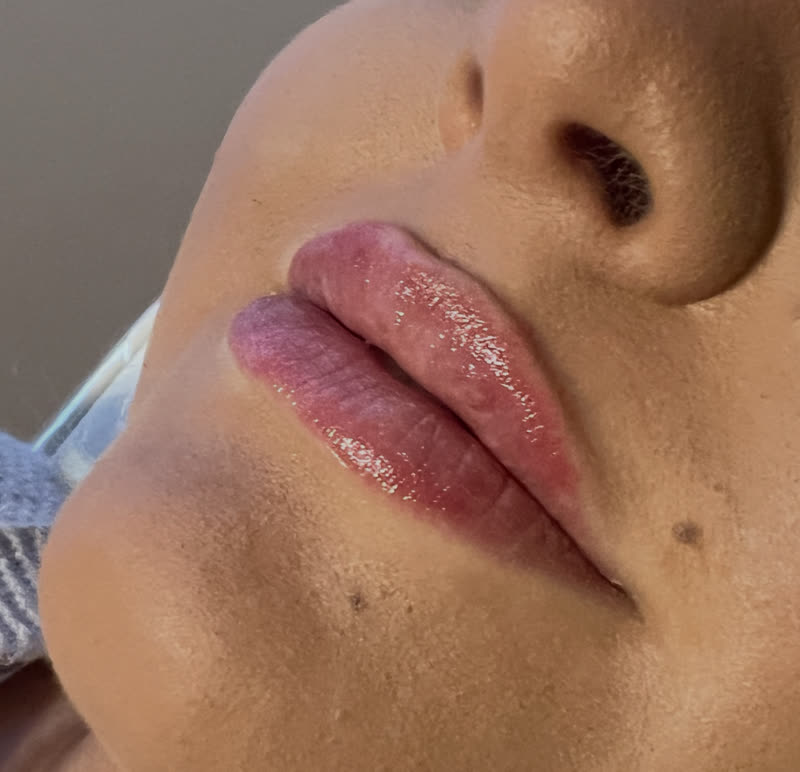
The honest answer up front
Dermal fillers last 6 to 18 months depending on the area treated and the product used. Lips sit toward the shorter end of that range, usually 6 to 12 months, because they are one of the most mobile areas of the face. Every word you speak and every cup of tea you drink works that filler a little harder than filler resting in a cheek.
That range is wide, and it is wide for a reason. Two clients can have the same product, placed the same day, by the same injector, and one will book a top up months before the other. The sections below explain why.
What lip filler is, briefly
Lip filler is a smooth gel made of hyaluronic acid, a substance that occurs naturally in your skin. Once placed, your body treats it as its own and gradually breaks it down. That is why filler fades, and it is also a safety feature: hyaluronic acid fillers can be dissolved early by a medical professional if ever needed.
At the clinic Hayley works with three premium ranges: Revolax, Juvederm and Stylage. Each has its own consistency and longevity profile.
Five things that decide how long yours lasts
1. The product
Filler ranges are built differently. Firmer, more structured gels tend to hold their shape longer, while softer gels give a more fluid, natural movement but can break down sooner. This is a conversation worth having at consultation, because the least expensive product and the longest-lasting one are not always the same.
2. How much is placed
A conservative first treatment uses less product, and less product has less to lose. If you start subtle, which Hayley recommends for most first-timers, expect the change to soften a little sooner than a fuller treatment would.
3. Your metabolism
Your body clears hyaluronic acid at its own pace. Clients with faster metabolisms, and often those who train hard several times a week, tend to break filler down more quickly. It is not a reason to stop exercising. It is a reason to expect your timeline to be yours.
4. How much your lips move
Lips talk, eat, smile and purse all day. Constant movement is the main reason lip filler fades faster than filler in stiller areas of the face like the chin or cheeks.
5. Lifestyle
Smoking and regular unprotected sun exposure both stress the skin and may shorten how long results hold. Good hydration and daily SPF will not make filler permanent, but they give it, and your skin, the best chance.
A realistic timeline for your first treatment
- Days 1 to 3. Mild swelling or bruising is normal and settles within 1 to 3 days. Your lips will look slightly fuller than the final result during this window.
- Weeks 1 to 2. The filler settles and softens into the lip. This is your true result, and the right time to judge whether you love it.
- Months 1 to 6. The settled period. Definition and volume hold steady for most clients.
- Months 6 to 12. Gradual softening. Most clients notice the border definition fading first, then the volume. This is the natural window for a top up conversation.
How you will know it is fading
Filler does not vanish on a Tuesday. It softens in stages, and knowing the stages stops you panicking at the mirror. The border definition usually goes first: that crisp edge along the lip line becomes gentler. Volume follows, gradually, over weeks. Hydration tends to linger longest, so even late-stage filler often leaves lips feeling smoother than before you started.
A useful habit: take a photo in the same light, same angle, once a month. Memory is a terrible judge of gradual change. Photos tell you plainly whether your lips have actually softened or whether you have just got used to them, which happens to almost everyone.
How to help your results last longer
No routine makes filler permanent, and anyone promising otherwise deserves a polite goodbye. What genuinely helps:
- Follow the aftercare instructions you are given on the day.
- Wear SPF daily. Sun damage degrades skin and everything in it.
- Stay hydrated. Hyaluronic acid holds water, and it works better in a hydrated body.
- If you smoke, this is one more reason on the long list to cut down.
- Choose a qualified medical injector using premium products in the first place.
When to book a top up
Top up when your lips tell you to, not when the calendar does. Some clients return at six months, others stretch past a year happily. A smaller top up before the filler fully fades usually needs less product than starting again from scratch, which is kinder to your budget too.
If you are unsure whether it is time, a consultation settles it. Hayley will tell you honestly if you do not need more yet. Full pricing is on the price list page, with dermal fillers starting from £150.
Lip filler or lip flip: which lasts longer?
Worth knowing before you book either. A lip flip is not filler at all. It uses a tiny amount of anti-wrinkle product to relax the muscle above the top lip, letting more of your natural lip show. No volume is added, nothing is placed inside the lip itself.
Because it is an anti-wrinkle treatment, a lip flip follows anti-wrinkle timelines: results typically last 3 to 4 months, noticeably shorter than filler. It also costs less per treatment, suits people who want subtle change with zero added volume, and is one of the precision add-ons on the clinic's treatment menu.
Some clients use a lip flip as a first step to test how a subtle change feels before committing to filler. Others combine the two. Which route fits you is exactly the kind of question a consultation answers in five minutes.